Judge dismisses National Guard mobilization suit after loss at Supreme Court
CHICAGO — A federal judge on Monday, April 20, officially closed the book on a lawsuit filed against the federal government last fall when the White House ordered 500 National Guard troops to Chicago as the “Operation Midway Blitz” mass deportation campaign was escalating.
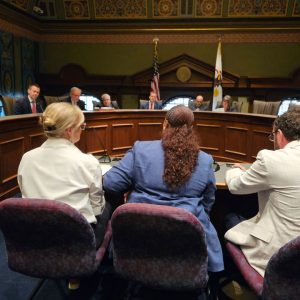
U.S. District Judge April Perry, whose October 9 temporary restraining order restricted any true deployment of the guardsmen to the streets of Chicago, declined to grant the state of Illinois’ and city of Chicago’s joint motion to keep the case alive in order to protect against any future National Guard mobilization orders from the administration. “The court can no longer provide ongoing protection against hypothetical unlawful acts committed by the federal government,” the judge said Monday, delivering her opinion from the bench after hearing lawyers’ brief oral arguments.
Shortly before Christmas, a 6-3 majority on the U.S. Supreme Court upheld Perry’s order, writing in its decision that the Trump administration had “failed to identify a source of authority that would allow the military to execute the laws in Illinois.” By that point, Operation Midway Blitz had wound down — with the exception of a short mid-December return to Chicago — and the last of the National Guard troops left the area by mid-January.
Read more: Supreme Court rebuffs Trump’s planned National Guard deployment to Chicago
The 300 or so members of the Illinois National Guard that the Trump administration federalized via a pair of orders on October 4 remained under the Trump administration’s control until then. The roughly 200 members of the Texas National Guard, mobilized via an October 5 order from Defense Secretary Pete Hegseth, were sent back to their state at the same time U.S. Customs and Border Patrol agents left the Chicago area in November.
Perry on Monday said she found all three of those orders had expired, even taking into account Hegseth’s December 22 extension of the Illinois National Guard takeover until April 15.

Lawyers from Illinois Attorney General Kwame Raoul’s office and those representing Chicago Mayor Brandon Johnson’s Law Department worried that without those orders being officially rescinded, the Trump administration might try to reuse them after the case was dismissed.
Christopher Wells, a top lawyer in the attorney general’s office, pointed Perry to a Dec. 31 post from Trump on his Truth Social account that promised Chicago “we will come back, perhaps in a much different and stronger form, when crime begins to soar again — only a matter of time!”
But Stephen Tagert, an attorney with the Department of Justice, told Perry the orders “are no longer operative” and that the case had to be dismissed as moot after the Supreme Court’s December 23 decision. Perry agreed, telling Wells that “issuing an injunction against future unlawful federalization in Illinois … would be inappropriate.”
“I honestly don’t know what to make of those particular social media messages,” the judge said of Trump’s posts, noting that the December 31 message was “about crime control, which was not at all what this deployment was supposed to be about.”
‘Things in Chicago are calm’
When leaving Chicago in November, then-Border Patrol Commander Gregory Bovino also threatened to return to Chicago in March with many more agents than the 200 on the ground in the fall. But Bovino and his boss, former U.S. Department of Homeland Security Secretary Kristi Noem, were both removed from their posts earlier this year following a chaotic deployment in Minneapolis that resulted in the deaths of two U.S. citizens.
“Things in Chicago are calm,” Perry said Monday. “They have been calm for many, many months. While that could change at any time, there’s no imminent thread of it happening soon.”
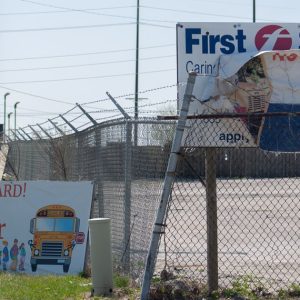
Of the 500 National Guard troops deployed to the Chicago area in early October, only a small portion of guardsmen were active for a single day before Perry issued her temporary restraining order. The troops were briefly stationed at the U.S. Immigration and Customs Enforcement processing facility in Broadview, a near-west suburb of Chicago that had become the epicenter of protests against the federal government in the weeks since Operation Midway Blitz began in September.
Read more: Judge’s block on deploying National Guard extended indefinitely as Supreme Court weighs case | Judge calls feds ‘unreliable,’ temporarily blocks National Guard deployment to Illinois
Both the Illinois and Texas guardsmen spent their extended stays at the National Guard training site in Marseilles and the U.S. Army Reserve Center near Joliet — 81 and 53 miles southwest of Chicago, respectively — performing training exercises, according to federal officials at the time.
Capitol News Illinois is a nonprofit, nonpartisan news service that distributes state government coverage to hundreds of news outlets statewide. It is funded primarily by the Illinois Press Foundation and the Robert R. McCormick Foundation.