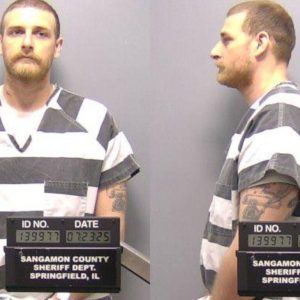
A woman’s death was the first fatal shooting by Illinois State Police this year. Were the trooper’s actions justified?
On a Sunday night in early January, Rachel Tarrence stopped in the drive-thru lane of an East St. Louis liquor store to buy cigarettes for a friend who sat beside her. Her four-year-old son was strapped in his car seat in the back. Seconds later, she was dying.
Those few moments, caught on police and surveillance video, captured a chaotic scene as four Illinois State Police troopers surrounded Tarrence’s vehicle. She put the car in reverse, hitting the squad car behind her. Troopers emerged from their vehicles and surrounded a panicked Tarrence, shouting conflicting orders, guns drawn and pointed at her. One trooper perceived a deadly threat and fired three shots through the windshield, fatally striking Tarrence in the chest.
A review by Capitol News Illinois found this was the only time in more than a decade that State Police used lethal force against an unarmed woman. But six months after Tarrence died at a St. Louis hospital, the public still doesn’t know whether the trooper was justified in firing those fatal shots at the 40-year-old mother of three.

The shooting occurred on January 4, three days before Renee Good, a 37-year-old mother of three, died on a Minneapolis street after an Immigration and Customs Enforcement agent fired into her fleeing vehicle. Good was attempting to disrupt the efforts of ICE agents in detaining people without legal status in the U.S. While federal agents said Good tried to run them over at a high rate of speed. The killing sparked national protests and spawned multiple investigations.
Good’s shooting drew nationwide condemnation, including from Illinois Gov. JB Pritzker, who criticized the Trump administration’s characterization of Good as a domestic terrorist. “It’s clear that this woman who was killed, this mother who was killed, was moving very slowly, not attempting to go after anybody,” Pritzker said the day after Good’s shooting.
In contrast, Tarrence’s shooting received little or no attention. No one took to the streets. The governor didn’t comment on her death. And the only investigation was launched by the same state agency that employed the trooper who fired the fatal shots, the Illinois State Police. Months after the completion of that investigation in February, there still is no definitive answer on whether the trooper so feared for his life or the lives of others at the liquor store that the only action he could take was to shoot.
Tarrence, who was white and lived in suburban Maryville, was shot in East St. Louis, a city that is 95% Black. With a history of substance abuse and running from the law, Tarrence inarguably was flawed, said Edwardsville attorney Troy Walton, who represents the family. But he contended the trooper ended her life unnecessarily.
“Pritzker has been on Trump’s ass about Minnesota,” Walton said. “Well, there’s some very similar troubling behavior here in Springfield on the part of the Illinois State Police.”
There have been 14 other officer-involved shootings by ISP since 2015, according to State Police data released to Capitol News Illinois. Tarrence was not armed and is the only woman to be fatally shot by a State Police trooper during that time.
Thirteen of those shootings involved suspects with guns. The other case was of a man fatally shot in the village of St. Joseph, Illinois, in Champaign County. Though he was suspected of shooting two people at an Iowa hospital, police noted it was “undetermined” whether he was armed at the time he was shot. Tarrence did not have a gun or weapon at the time of her shooting, according to reports.
Tarrence also is one of 13 people fatally shot by all law enforcement in Illinois so far this year, according to State Police statistics. ISP completed its investigation into the Tarrence shooting on February 13, six weeks after her death. The agency turned the findings over to the St. Clair County state’s attorney’s office for a determination of whether the shooting was justified, and whether the trooper will be prosecuted. The case is pending. State’s Attorney Jim Gomric’s office did not respond to a request for comment.
What happens now?
The Illinois State Police’s Division of Internal Investigations probes shootings by ISP troopers, unlike local law enforcement officer-involved shootings. Those are investigated by ISP’s Division of Criminal Investigations.
In Tarrence’s case, the St. Clair County state’s attorney’s office, formerly headed by now-Illinois State Police Director Brendan Kelly, will make the call of whether the shooting was justified or criminal charges are warranted. After prosecutors review the investigation, they will issue a determination whether the shooting was lawful. Under the law, a trooper is justified in using deadly force if they reasonably believe their life or the lives of others are in danger.
Until that determination is made, the trooper involved remains on paid administrative leave. The other three troopers who were there but did not fire their weapons have returned to duty. None has been identified.
In St. Clair County, the review is further complicated by the State Police’s commitment to fighting crime in areas with limited resources, such as East St. Louis, Walton said. The additional state resources have helped drive down the homicide rate in East St. Louis, which once had the highest homicide rate per capita in the country.
On Sunday, for example, Illinois State Police were investigating a mass shooting that involved seven family members shot at three locations in the city. Five people died. Two juveniles, ages 15 and 16, are being held. “When prosecutors are looking at this case, I think they know that the Illinois State Police do a lot of good in places like Washington Park and East St. Louis. The prosecutors work together with them all the time to battle crime in places like this, so they are given a lot of the benefit of the doubt, I think,” Walton said.
Walton predicted no charges would be issued. With the investigation completed and the expectation that prosecutors would find the shooting justified, Walton predicted this case would go away, clearing the way for the trooper to return to work. “He’ll return in short order,” Walton said.
The public may never know the name of the trooper who shot Tarrence. The union contract bars the ISP from releasing the name of the officer unless they are criminally charged or indicted, or if a disciplinary decision is made by the Illinois State Police Merit Board, according to a state police spokesperson.
“We can’t know who he is, but everyone knows who she is and what her past looks like,” Walton said.
In some cases, prosecutors issue a letter or report detailing reasons for a determination. Most conclude that a police shooting was lawful while never describing the circumstances, the legal justification for the finding or the officer’s identity, background, disciplinary record or training.
In the Minnesota case, federal officials initially declined to identify the customs agent who shot Good, citing safety concerns. But journalists uncovered Jonathan E. Ross’ identity after finding a case where he was named in court documents claiming he had been severely injured when he was dragged by a vehicle.
The ISP trooper’s identity could be made public if a civil suit is filed in state or federal court. Any settlement in the case would be paid by Illinois taxpayers.
History of running from police
Tarrence struggled with depression, anxiety and substance abuse, according to those who knew her. She tried to beat the addiction with two stays in an in-patient treatment program, but Walton said that in the week before her death, she once again gave in to her demons.
Toxicology results from her autopsy showed she had used cocaine in the hours before her death, according to the St. Louis City Medical Examiner’s report, but not enough to cause psychosis or to greatly impair judgment. Tarrence also had a history of failing to return cars borrowed from friends and family, and of trying to outrun police.
In 2021, a man loaned his 2013 Honda CRV to Tarrence, giving her permission to drive the car from a Belleville hospital to her Maryville home, according to a police report. The man called Tarrence repeatedly over the course of five days, asking her to return his car. She asked the owner if she could take the car to Kentucky. The man refused and once again demanded she return the car. She didn’t, and the man called the police.
About two weeks after the Honda was reported stolen, police spotted it with Tarrence driving. They tried to pull the car over, but Tarrence wouldn’t stop, according to a police report. The high-speed, mid-day chase wound through Madison and into Granite City. “I could see in the distance the vehicle traveling at a high rate of speed towards me. Numerous squad cars from numerous jurisdictions were following the car but were unable to maintain a following distance from the suspect vehicle,” according to a Granite City police officer’s report.
Officers deployed stop sticks, flattening the Honda’s passenger side tires. Flat tires didn’t stop the chase. The car still raced down Granite City’s business district, striking a detective’s car. The Honda kept going, traveling down alleys and residential streets before getting to a city park where people strolled and children played, the police report stated.
At one point, the Honda left the street and drove into the park, speeding through a baseball field and ice rink parking lot, nearly hitting people and parked cars. Granite City police cars performed a rolling barricade and stopped the car, and Tarrence was arrested.
Madison County prosecutors charged her with possession of a stolen vehicle, aggravated fleeing, two counts of aggravated battery of a police officer, and two counts of criminal damage to state property. Nine days after she was charged, she pleaded guilty. In exchange for her plea, prosecutors agreed to a sentence of four years of probation and 200 hours of community service.
On November 6, 2023, Tarrence was involved in another but less dramatic chase, running from O’Fallon police who were investigating a theft. In the report, the officer noted Tarrence did not exceed the speed limit and signaled when changing lanes but refused to stop even when he pulled alongside her and made eye contact. Officers aborted their pursuit, but they later found her at her Maryville home and impounded a Mercury she had been driving.
Eleven months later, Tarrence’s mother called police to report that Tarrence had borrowed her car without permission, but the mother didn’t want to pursue charges.
Then on December 10, 2025, a State Police trooper ticketed her for driving on a revoked license and attempting to flee from the police in her 2018 Hyundai Sonata.
On the morning of the fatal shooting, Washington Park police arrived at her mother’s Maryville home and impounded Tarrence’s car. Tarrence asked whether she could take her mother’s car to take a friend home to Trenton, but her mother refused. Undeterred, Tarrence took the keys, hopped in her mother’s 2024 Chevrolet Equinox with her four-year-old son and left. It was around noon on January 4 when her mother called police and reported her car stolen. This time, she wanted to press charges, a police report stated.
Though the police radio alert stated Tarrence stole her mother’s car, Walton said Tarrence called her mother three or four times throughout the day. A surveillance video captured Tarrence stopping at a fast-food restaurant, picking up Happy Meals for her three kids and food for her mother. “She cared about people. She loved them. She loved God. An imperfect person, but a person who cared,” Walton said. “Now, there are three kids without a mother. For what?”
How the shooting unfolded
Around 8 p.m., ISP received a report that a stolen 2024 Chevrolet Equinox crossed into East St. Louis from Missouri. Four squad cars caught up with the car in the 4500 block of State Street as Tarrence pulled into the Rainbow Liquor Mart drive-thru. Tarrence was a regular there, the owner told local media, so she knew the layout of the drive-thru, which had a two-foot drop about 50 yards in front of the drive-thru and a sharp right turn down a gravel road to exit.
In the video taken from an ISP camera, two police sport utility vehicles pulled along the passenger side, one just in front of her front passenger bumper and the other near the passenger door. Another squad car pulled up behind her and one off the rear driver’s side. Emergency lights flashed.
Tarrence then put the car in reverse, striking a police car behind her. One trooper whose car blocked the Equinox car jumped out of his car with his gun drawn. Troopers can be heard shouting commands.
Marc Brown, a professor at the University of South Carolina School of Law who teaches control tactics and use of force, reviewed the police video and gave his opinion. Brown said troopers improperly pinned Tarrence’s car, failing to pull up close enough in front and back of the car to prevent her from moving. Also, several troopers can be heard shouting different instructions. One yelled, “Put it in park!” Another shouted for Tarrence to put her hands up. Instead, Tarrence put the car into reverse and backed into a police car.
“That’s one of the reasons for the chaos. You have that much coming at you at one time, it may, it can cause a different reaction,” Brown said. “If you have two people shouting, ‘don’t move, drop the gun,’ the suspect can say, ‘Okay, what should I do? Do I not move or drop the gun?’”
Officers did nothing to de-escalate the situation, Walton added. “This trooper escalated this situation at such a rapid rate that she didn’t have time to adjust. The flashing lights, conflicting commands, loud voices. She panicked. She just hit a police car with her mother’s car,” Walton said.
While the scene was chaotic, Brown said trained officers should be measured in their responses. “On the law enforcement side, it’s very controlled. One person is giving directions. One person is telling them what to do. Everybody else is contributing to make sure they do it,” Brown said.
After backing into the police cruiser, a visibly flustered Tarrence can be seen in the video turning on the windshield wipers. A trooper steps toward the car. The wheels are nearly straight. When the car moves forward, the trooper moves toward the front of the car, but because of the way the tires are turned doesn’t appear to be in the path of the car. “If he was in any danger, he put himself in harm’s way,” Walton said.
As he fires three shots, he steps back. Firing into a moving car is risky, Brown said. “A generally accepted practice I’ve seen from agencies is we’re not shooting into moving vehicles. We’re not shooting into vehicles because you don’t know. You may be shooting at the driver, but a vehicle such a small, close space, you don’t know if those bullets or those rounds will over-penetrate, injuring someone else, or if you shoot and incapacitate the driver while the vehicle is still moving, you may injure another,” Brown said.
ISP troopers are trained extensively on the use of force. The policy states that troopers will not discharge a firearm at, or from, a moving vehicle unless the use of deadly force is justified by the perpetrator’s implied or actual physical actions against the officer that would lead to great bodily harm or deadly force.
When the unidentified trooper begins firing, the adult male in the passenger seat can be seen flailing his arms, according to the video. The four-year-old in the back seat strapped in a child car seat can’t be seen. Outside the car, another trooper positioned himself on the driver’s side of Tarrence’s car and appeared to be in the line of fire.
An autopsy revealed that Tarrence was shot three times, twice on the right side of her chest, once in the right forearm.
In the Minnesota case, Good was shot four times. The circumstances of the two shootings are eerily similar. Good stopped sideways in the street while the agent circled her car. As other agents approached, one told her to get out of the car. Good briefly put the vehicle in reverse, then began moving forward and to the right, into the direction of traffic. At this point, Ross, the ICE officer, was standing at the front-left of the vehicle and fired, killing her. Good’s vehicle moved on, turning away from him. Good’s dog was the only other occupant of the car when the shooting occurred. The dog was not injured.
In Tarrence’s case, her four-year-old son was in the car, as well as another passenger. Neither was injured. But Walton questioned how witnessing his mother’s death may impact the preschooler. Then, there are two other children who were left motherless. “This didn’t have to happen. Nothing that she did that day deserves the death penalty,” Walton said.
Capitol News Illinois is a nonprofit, nonpartisan news service that distributes state government coverage to hundreds of news outlets statewide. It is funded primarily by the Illinois Press Foundation and the Robert R. McCormick Foundation.